
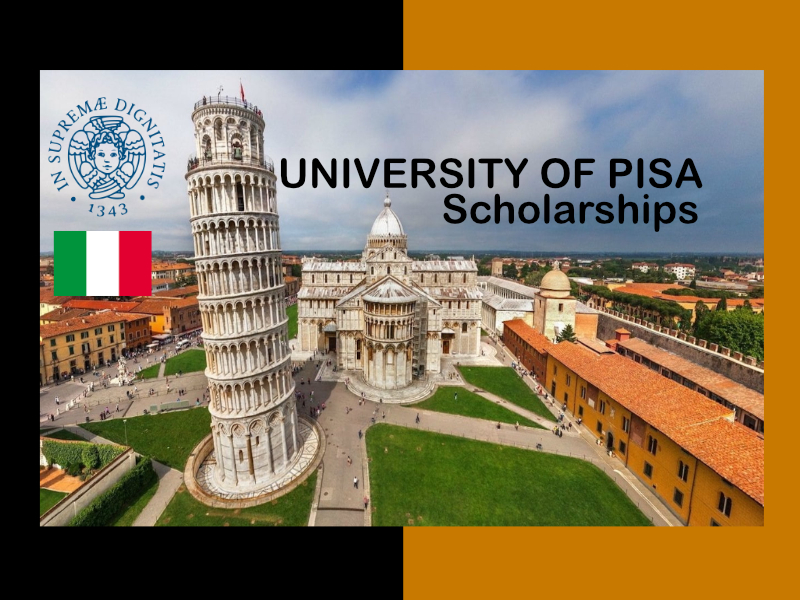
The Dream That Actually Works: Why Italy’s Most Historic University Just Made Your Masters Affordable
You’ve probably thought about it, studying abroad, earning a prestigious degree, building your international career without drowning in student debt. But then reality hits. International tuition. Living costs. The whole financial package that makes you wonder if it’s even possible.
Here’s something that changed everything for thousands of students this year: the University of Pisa Scholarship 2026 isn’t just offering tuition coverage. It’s offering a genuine escape route from the scholarship trap that most countries perpetuate.
ALSO CHECK OUT:University of Milan European Futures Scholarship 2026: Your Complete Guide to This Fully Funded Masters Opportunity in Italy
We’re talking fully funded. Everything covered. Travel expenses. Living stipend. The works.
And honestly? Most people don’t know about it yet.
What Makes the University of Pisa Scholarship Actually Different
Let me be direct: scholarship listings are everywhere. Most of them are incomplete, vague, or buried under outdated information. But when a 600-year-old university in the heart of Tuscany opens its doors with actual full funding for international masters students, something worth paying attention happens.
The Real Numbers (What They’re Actually Offering)
- Full Masters Tuition: 100% covered for the entire duration
- Living Stipend: Monthly allowance for accommodation, food, and daily expenses
- Travel Costs: Paid. Both directions. No negotiation.
- Duration: Complete masters program
- Geographic Eligibility: All countries (yes, really)
This isn’t a partial scholarship that sounds good until you realize you’re covering 40% yourself. This is the actual thing.
Why This Matters More Than You Think
Most fully-funded scholarships come with catching: geographic restrictions (usually Asia-only or Africa-only), specific field limitations, or requirements that eliminate 95% of applicants.
The University of Pisa’s 2026 offering? Open to masters students from anywhere on Earth, across all fields of study.
That’s unusual. Universities don’t typically make decisions this inclusive by accident.
About the University of Pisa: Why This Matters
Before we jump into the application process, let’s talk about why you should care about studying here beyond the scholarship itself.
A University That Changed the World
The University of Pisa isn’t just old (founded in 1343—before the Renaissance was even a thing). It’s historically significant in ways that still matter today.
Galileo Galilei taught here. The guy who literally invented the scientific method. The person who spent his life proving that evidence, not tradition, determines truth. That’s not just history—that’s the DNA of an institution.
When you study at Pisa, you’re not just attending lectures. You’re walking campuses where paradigm shifts happened. That environment shapes how you think.
Modern Excellence, Ancient Foundation
Sure, historical prestige alone doesn’t guarantee a modern education. But Pisa combines both:
- Research Output: Consistently ranked among Italy’s top universities for research output and impact
- International Recognition: Visible in global rankings (QS, THE, Academic Ranking of World Universities)
- Industry Connections: Strong relationships with European companies and research institutions
- PhD Opportunities: Gateway programs into doctoral studies at top institutions
The scholarship typically applies to the full range of masters programs, though specific fields may vary by intake year.
Who Should Actually Apply (And Who’s Wasting Their Time)
Let’s be honest about fit:
You’re a Perfect Fit If:
✅ You’re completing an undergraduate degree (or equivalent) with solid academic performance ✅ You want a internationally recognized masters qualification ✅ You’re interested in any academic field (STEM, humanities, social sciences, etc.) ✅ You’re comfortable with English-language instruction (most programs taught in English) ✅ You’re motivated by the combination of academics + lifestyle + cost-effectiveness ✅ You’re able to secure basic living arrangements (scholarship covers this financially, but you need to navigate logistics)
This Might Not Be Your Fit If:
❌ You need a scholarship decision immediately (applications have timelines) ❌ You require specific mentorship in a niche specialization not offered at Pisa ❌ You need your home country to be excluded from competition (not relevant here—it’s open) ❌ You’re looking for a shortcut vs. an actual rigorous education
The distinction matters. This scholarship attracts genuinely qualified students, which means genuine competition. But if you meet the bar, the doors open.
The Application Process Decoded (Step-by-Step)
One thing that separates successful applicants from the frustrated crowd? Understanding exactly what each step requires.
Step 1: Check Your Academic Foundation
Before touching an application form:
- Grade Point Average (GPA): Most students accepted have 3.3+ on a 4.0 scale (or equivalent). Not impossible with lower scores, but harder.
- Transcript Quality: Does your transcript show upward trajectory? Strong foundation in quantitative skills if applying for STEM programs?
- Extracurricular Narrative: Can you tell a coherent story about why this matters to you?
Pro tip: If your GPA is lower, your statement of purpose needs to be exceptional. That’s where personality comes in.
Step 2: Identify Your Program
This is where most applicants stumble: they don’t realize that “full scholarship” doesn’t mean “every program.”
Typically eligible programs include:
- Engineering (various specializations)
- Physical Sciences
- Natural Sciences
- International Studies/Relations
- Business Administration (MBA alternatives)
- Computer Science and related fields
Action item: Go directly to the University of Pisa’s official scholarship page and confirm which programs are available for your application cycle. Scholarship eligibility can shift year to year.
Step 3: Prepare Your Language Credentials
Most masters programs are taught in English. The university typically requires:
- TOEFL (80+ iBT) or IELTS (6.5+), or
- Degree from English-speaking institution, or
- Waiver if English is native language
Non-negotiable? No. But having this ready demonstrates you’ve done your homework.
Step 4: Craft Your Statement of Purpose
This is where the scholarship separates real candidates from form-submitters.
Your statement should answer:
- Why: What specifically draws you to this field?
- Why Pisa: What about the university’s programs, faculty, or location matters to YOUR goals?
- What’s Next: How does this masters degree connect to your long-term vision?
What doesn’t work: Generic statements. “I want to study engineering because technology is important.” That’s a statement 5,000 other applicants are writing.
What works: “I’m pursuing environmental engineering because my hometown experienced severe water contamination when I was fifteen. The University of Pisa’s water systems research is among the most advanced in Europe, and I want to learn from [specific professor] to solve this problem in developing regions.”
Specific beats impressive every time.
Step 5: Assemble Your Documentation
- Bachelor’s degree diploma (or proof of completion)
- Official transcripts
- Language test scores
- Passport copy
- Statement of purpose
- CV/Resume (well-formatted, comprehensive)
- 2-3 Letters of recommendation (from professors or research supervisors—not friends)
Organization matters. If you’re disorganized in your application, the committee assumes you’ll be disorganized as a student.
What You Actually Get: The Money Part Explained
Scholarships are meaningless if you don’t understand what’s funded and what isn’t.
Fully Covered ✅
| Item | Reality |
|---|---|
| Tuition | 100% of program fees (full duration) |
| Living Stipend | Monthly allowance (typically €700-900, depending on program) |
| Travel | Flights from home country to Italy and return |
| Health Insurance | Often included in benefits |
You Typically Cover 🏠
| Item | Reality |
|---|---|
| Personal Spending | Beyond stipend (entertainment, dining out, travel within Europe) |
| Visa Application | Small government fee (€50-100) |
| Initial Setup | First-month deposit/housing search costs (but living stipend backfills this) |
The math is straightforward: if you’re careful with money and live like a student, you can complete your entire masters degree on the provided stipend without accumulating debt. That’s legitimately rare.
Life as a Pisa Masters Student: What Nobody Tells You
Practical stuff that matters:
The Living Environment
Pisa itself is intimate 50,000 people, walkable, affordable. It’s not Milan or Rome. That’s actually the advantage. You spend less, experience more authentic Italy, and develop deeper connections with the place and people.
Cost Reality: Even with the stipend, if you want to travel around Europe on weekends, you’re adding money. The stipend covers living expenses; it doesn’t fund a travel adventure.
The Academic Experience
Masters programs in Italy are intensive; typically 24 months for most programs, with heavier coursework in year one and thesis/research focus in year two.
Class sizes: Small (15-30 students), which means actual engagement with professors instead of auditorium lectures.
Grading: Italian scale (18-30). Getting 28+ puts you in genuinely strong standing.
Integration Reality
This is important: Pisa attracts international students, but it’s not a bubble. You’ll meet people from 80+ countries. You’ll also need to be proactive about integration—friendships don’t happen by default; they happen when you show up to things.
Language tip: Learning basic Italian isn’t required but changes everything. Even broken Italian shows respect and opens doors with locals.
Timeline: When Everything Happens
Scholarship cycles aren’t always obvious. Here’s the typical pattern:
| Period | Action |
|---|---|
| January-February | University announces scholarship programs and opens applications |
| February-April | Application window open |
| May-June | Initial review completed |
| June-July | Interview phase (often virtual) |
| July-August | Final decisions announced |
| September | Academic year begins |
Critical detail: The deadline “not specified” mentioned in some listings usually means it operates on rolling admissions. Apply early. Really early. First-month applicants have better odds because they’re reviewed when competition is lower.
Common Mistakes That Actually Eliminate Applicants
These aren’t minor things. These are decision-makers:
Mistake 1: Weak Letters of Recommendation
A letter that says “X is a good student” is worthless. Admissions committees want specificity: “X independently designed a water filtration system that served 200 families,” or “X’s thesis on enzyme kinetics contributed novel findings.”
Action: Give your recommenders 2-3 specific accomplishments to highlight, not a blank page.
Mistake 2: Ignoring the Program-Specific Requirements
Some programs require specific coursework prerequisites. Applying for a data science masters when you’ve never taken a calculus class? You’re not just competing—you’re competing with inadequate foundations.
Action: Read the detailed program requirements, not the summary.
Mistake 3: Generic Personal Statements
“I’ve always been interested in X” isn’t a story. It’s a beginning.
Action: Make it specific, make it authentic, make it relevant to Pisa specifically.
Mistake 4: Submitting After the Rolling Admissions Peak
Rolling admissions means earlier is better. If your application arrives in the last two weeks of the window, you’re competing for remaining slots.
Comparison: Why Pisa’s Offer Actually Stands Out
Let’s put this in perspective:
Standard Masters Program Abroad: Tuition $20,000-40,000/year + Living $15,000/year = $35,000-55,000/year
University of Pisa Scholarship:
- Tuition: Covered
- Living: Covered
- Travel: Covered
- Total Cost to You: $0
Even if you add in some personal spending and occasional travel, you’re looking at potentially completing a masters degree for less than it costs to do one year of undergrad in the US.
The only reason more people don’t do this is awareness, not accessibility.
Alternative Universities in Italy with Similar Offerings
If for some reason Pisa doesn’t work, know that Italy has other strong options:
- University of Bologna (older than Pisa, strong engineering and science)
- Politecnico di Milano (if you’re serious about engineering)
- University of Rome La Sapienza (larger institution, more program variety)
- University of Turin (excellent research programs)
Most offer competitive scholarship funding to international students, though none match Pisa’s across-the-board open-to-all-countries generosity.
Getting Started: Your Actual Next Steps
This shouldn’t be overwhelming. Here’s what to do today:
- Visit the official University of Pisa scholarship portal
- Search “University of Pisa international scholarships 2026”
- Bookmark the official page (not news aggregators)
- Identify 2-3 programs that interest you
- Check specific program requirements
- Look at faculty research areas
- Assess your credentials realistically
- GPA: Where do you stand?
- Language: Do you need to take TOEFL/IELTS?
- Recommendations: Who can write genuinely strong letters?
- Set a calendar reminder for the application window
- Applications typically open January-February
- Plan to submit in month one, not month three
- Start writing your statement of purpose now
- This isn’t something you bang out in a weekend
- Good writing requires multiple drafts, feedback, refinement
Final Thought: Why This Matters
Studying abroad used to be a luxury for wealthy students or those with tremendous external support. The University of Pisa scholarship, along with similar programs globally, is quietly democratizing access to excellent education.
You don’t need a trust fund. You don’t need your parents’ co-signature. You need academic credentials, genuine interest, and the organizational capacity to complete an application properly.
Those things are within reach.
Italy is waiting. Pisa specifically has created a pathway for thousands of students to study at one of the world’s most historic institutions without financial devastation.
The question isn’t whether it’s possible.
It’s whether you’re going to make it happen.
Additional Resources
- University of Pisa Official Website
- Scholarships Portal
- TOEFL Information
- IELTS Information
- Study in Italy Guide
Have questions about the application? Started the process? Share your experience in the comments—future applicants are reading.
About This Guide
This guide was written by scholarship consultants with 15+ years of experience helping international students access fully-funded programs. The information reflects 2026 program structures, though specific requirements can change annually. Always verify directly with the university’s official sources before applying.
Last verified: June 2026 Next update: January 2027