
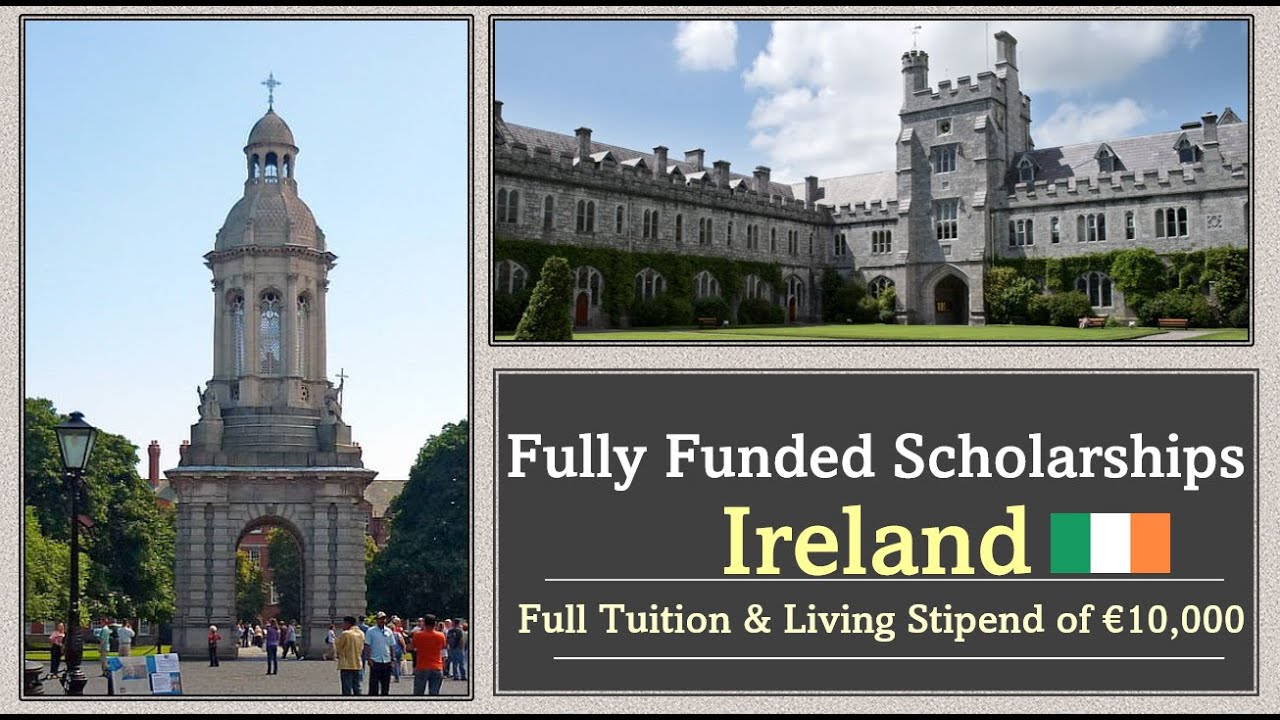
If studying in Ireland for free has been on your bucket list, 2026 is the year to make it happen. The Government of Ireland has opened applications for the Ireland Fellows Programme 2027/28, one of the most generous, fully funded scholarships available to professionals from developing countries. From tuition and flights to a monthly living stipend, this fellowship covers nearly every cost of earning a master’s degree at a top Irish university, and the application window is short, so timing matters.
Here is everything you need to know, from eligibility to deadlines, explained simply and based on the latest official guidance.
Scholarship Overview
The Ireland Fellows Programme is funded by the Irish Government through the Department of Foreign Affairs and Trade (DFAT) and Irish Aid. It gives early to mid-career professionals from eligible developing countries the chance to complete a fully funded, one-year master’s degree at a higher education institution in Ireland.
The programme isn’t just about academics. It’s built around leadership development and the Sustainable Development Goals (SDGs), so fellows return home equipped to drive change in their own communities. Nearly 4,000 people have studied in Ireland through this programme over the past five decades, and the 2027/28 intake is now open for applications.
SEE ALSO: Switzerland Government Scholarships 2027–2028: Fully Funded Guide
Courses run for 10 to 16 months and typically begin in August or September. Master’s programmes are available across a wide range of fields, including:
- Agriculture and sustainable development
- Public health
- Education
- Human rights and governance
- Computer science and engineering
- Business and development studies
- Climate and environment
- Gender equality
Eligible courses are listed in the official Directory of Eligible Programmes, and applicants can usually select up to three preferred master’s options.
Eligibility Requirements
Eligibility for the Ireland Fellows Programme varies by country and by strand, since the programme is actually a family of regional and named fellowships rather than one single award. Here’s how it breaks down:
Africa strand: open to residents of Angola, Djibouti, Democratic Republic of Congo, Eritrea, Eswatini, Ethiopia, Ghana, Kenya, Lesotho, Malawi, Mozambique, Rwanda, Senegal, Sierra Leone, Somalia, South Sudan, Tanzania, Uganda, Zambia, and Zimbabwe. Several African countries also have their own named fellowships with country specific guidance: the Kader Asmal fellowship (South Africa), Roger Casement (Nigeria), Seán Mac Bride (Namibia), Archbishop Michael Courtney (Burundi), and the Frank Ferguson Fellowship in Engineering (Zambia).
Asia strand: open to residents of Vietnam, Laos, and Cambodia.
Latin America strand: split into three named awards: the Central America Award (Belize, Costa Rica, El Salvador, Guatemala, Honduras), the Cecilia Grierson Award (Argentina, Bolivia, Paraguay), and the Roger Casement Award (Brazil, Colombia, Ecuador, Peru, Venezuela).
Small Island Developing States (SIDS) strand: covering the Caribbean (including Antigua and Barbuda, Bahamas, Barbados, Cuba, Dominican Republic, Haiti, Jamaica, Trinidad and Tobago, and others), the Pacific (including Fiji, Papua New Guinea, Samoa, Tonga, and others), and Africa/Indian Ocean/South China Sea states (Cabo Verde, Mauritius, Maldives, Timor Leste, Seychelles, and others).
Palestine: administered separately as the Ireland Palestine Scholarship Programme, which opens annually in September and is not part of the June application window.
Across all strands, applicants generally must:
- Be a resident national of one of the eligible countries listed for their strand
- Hold a bachelor’s degree from an accredited, government-recognised institution (Latin America strand applicants need a minimum GPA of 3.0 on a 4.0 scale, broadly equivalent to a first- or upper-second-class honours degree)
- Have a minimum of two to three years of substantial, directly relevant work experience (exact thresholds vary by country and strand)
- Demonstrate leadership potential, a commitment to the Sustainable Development Goals in their home country, and a wish to build lasting ties with Ireland
- Select up to three eligible master’s programmes from the Directory of Eligible Programmes
- Be available to start a new master’s programme in Ireland no sooner than August 2027
- Not have applied to the Ireland Fellows Programme more than once before
- Meet the academic English language requirements for their chosen course(s)
Importantly, several countries, including Burundi, the Democratic Republic of Congo, Eswatini, Eritrea, Kenya, Liberia, Malawi, Sierra Leone, Somalia, Sudan, and Zambia, run invitation-only fellowships restricted to staff of government departments or NGOs already partnered with Irish Aid. Unsolicited applications from these countries are not accepted, so check with your nearest Embassy of Ireland or employer first. Other countries run an open call where anyone meeting the criteria can apply directly.
Benefits of the Ireland Fellows Programme
This is genuinely a fully funded award. Successful fellows receive:
- Full tuition/academic fee coverage for their master’s programme
- Economy flights to and from Ireland
- Visa application fees and the Irish residence permit fee
- Medical and travel insurance for the duration of the fellowship
- A monthly living stipend to cover everyday costs
- Accommodation support, including arranged housing for the first two trimesters and a monthly accommodation allowance (roughly €800 to €1,000, depending on location) for the third trimester
- A settling-in allowance to help with initial costs on arrival
- A completion and departure allowance
- Access to a structured calendar of orientation events, networking opportunities, and skills training in leadership, project management, and conflict resolution
Note that the fellowship covers the recipient only; financial support and visas for spouses or dependants are not included. In short, fellows aren’t just funded to study. They’re supported to thrive socially and professionally throughout their time in Ireland.
Required Documents
While exact document checklists can vary by country and strand, applicants generally need:
- A valid passport
- Degree certificate and academic transcripts
- An updated CV or resume
- Two letters of recommendation
- A motivation statement or personal statement
- Proof of English language proficiency (if already taken)
- A recent passport-sized photograph
At Stage 2 of the process, original copies of these documents are typically required, so it’s wise to start gathering them early rather than waiting until you’re shortlisted.
Application Process
Applying to the Ireland Fellows Programme happens in three stages:
- Stage 1: Preliminary application (June/July). A shorter initial application covering your basic details, motivation, and chosen course preferences. This is submitted online through the official portal for your country.
- Stage 2: Detailed application (mid-September to mid-October). Only candidates who pass Stage 1 are invited by their local Embassy of Ireland to complete a more detailed form and submit original supporting documents.
- Stage 3: Interviews (November/December). Shortlisted candidates are interviewed and asked to sit an online Duolingo English Test. If you progress further, you’ll usually need to take an IELTS exam too, unless you already hold a valid certificate.
To apply:
- Visit the official Ireland Fellows Programme page and select your country.
- Read the country-specific Applicant Guidance Note carefully, since eligibility and strands differ by location.
- Review the Directory of Eligible Programmes and choose up to three master’s courses that match your background.
- Prepare your documents in advance.
- Submit your Stage 1 application before the deadline.
- If shortlisted, complete Stage 2 and prepare for interviews.
Deadline
Applications for the Ireland Fellows Programme 2027/28 are open from Monday, 29 June 2026 to Sunday, 26 July 2026. This is a hard, government-confirmed window for the Stage 1 preliminary application across all strands (Palestine is the exception, opening separately in September). Given the short four-week window, it’s worth starting your Stage 1 form as early as possible rather than waiting until the final days.
Official Application Link
Apply and find country-specific guidance through the official Government of Ireland website: 👉 www.ireland.ie/en/ireland-fellows-programme
For questions about eligibility or your application, contact your nearest Embassy of Ireland directly, as the programme is managed at embassy level for each eligible country.
Frequently Asked Questions (FAQs)
Is the Ireland Fellows Programme really fully funded? Yes. It covers tuition fees, flights, accommodation, a living stipend, and additional allowances for settling in and departure.
Who can apply? Early to mid-career professionals from eligible countries across Africa, Asia, Latin America, the Caribbean, Small Island Developing States, and Palestine, who hold a bachelor’s degree and don’t already have a master’s qualification.
Do I need an IELTS score to apply? Not necessarily at Stage 1, but Irish institutions require IELTS or an equivalent English certificate later in the process. Early preparation is strongly recommended, even for native English speakers.
How long does the fellowship last? Most master’s programmes run between 10 and 16 months, starting in August or September.
Can I apply if I already applied in a previous year? You generally cannot apply more than once for the same fellowship in a given cycle, so check your country’s specific guidance for rules on reapplying.
How many universities can I apply to? Most applicants can select up to three eligible master’s programmes from the official Directory of Eligible Programmes.
Conclusion
The Ireland Fellows Programme 2027/28 is exactly the kind of opportunity that can reshape a career: a fully funded master’s degree, a stipend to live on, and a global network, all in a country known for its warmth and world-class education. With applications open for only a few weeks, the smartest move is to check your country’s eligibility today, gather your documents, and submit your Stage 1 application well before the deadline. Opportunities this complete don’t come around often, and for the right candidate, this one could be life-changing.