
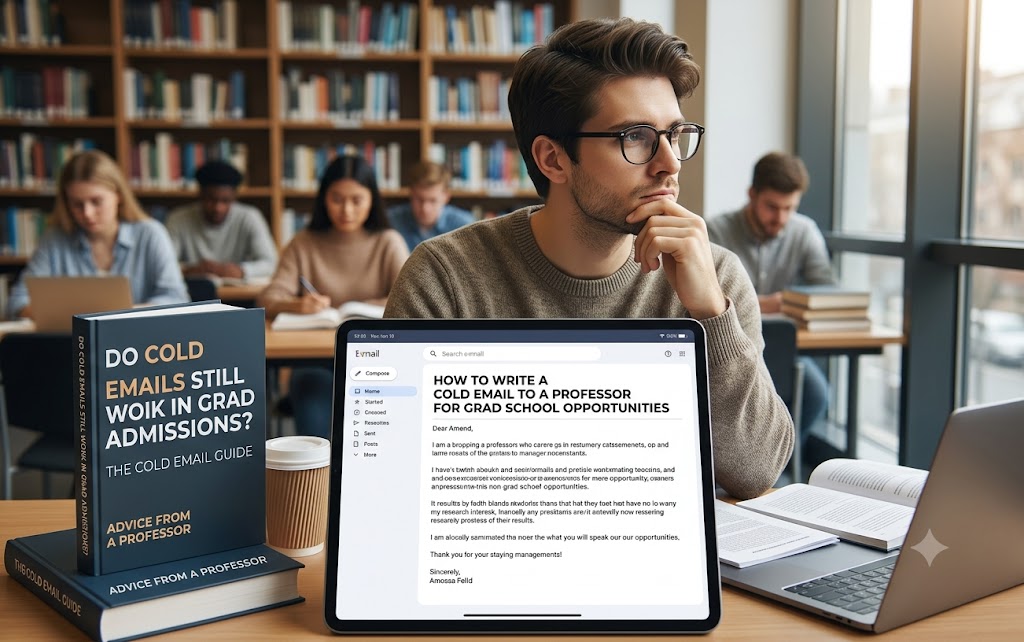
You finally find the professor whose research lines up perfectly with what you want to study for the next few years. You open your email, type “Dear Professor,” and then… nothing.
Now you’re staring at a blank screen wondering, What am I even supposed to say without sounding like every other student in their inbox?
Here’s the truth: professors receive dozens of emails from prospective students every week. And unfortunately, most of those emails get ignored or deleted within seconds.
It’s not always because the students aren’t qualified. Often, the email simply doesn’t give the professor a good enough reason to keep reading.
That’s where this guide comes in.
You’ll learn exactly how to write a cold email that grabs a professor’s attention, shows genuine interest in their research, and gives them a reason to respond. You’ll also get practical email templates, subject-line formulas, and tips on when to send your message for a better chance of getting noticed.
Most importantly, you’ll learn how to avoid the generic “I am interested in your research” email that professors have probably seen hundreds of times.
Why Most Cold Emails to Professors Get Ignored
Before you look at the templates, it helps to understand what you are up against. Professors are not ignoring you out of rudeness. Instead, they are triaging a full inbox, so they make a keep or delete decision fast. A few patterns kill an email before the first paragraph even finishes.
- No evidence you read their work. A line like “I am very interested in your research” with zero specifics reads as copy and paste.
- A vague or missing ask. Professors cannot act on “I would love to learn more.” They need to know exactly what you want.
- Long, unbroken paragraphs. Dense blocks of text signal effort for the reader, not for you.
- A generic subject line. A subject line that looks like a mass email gets filtered out fast, mentally and sometimes literally.
- Attachments with no context. A CV with no explanation makes the professor do extra work to figure out why it is there.
None of this is really about spam filters. It is about respect for someone’s attention. Fix that, and you are already ahead of most applicants.
Step 1: Do the Homework Before You Write a Word
The biggest factor in getting a reply is not a clever opening line. It is specificity. And specificity only comes from research. So before you draft anything, do this first.
- Read two or three of the professor’s recent papers. Abstracts count if you are short on time. Do not rely on the faculty bio alone.
- Check their lab website or Google Scholar profile. Look at whether they published in the last year or so. A quiet profile often means they are not actively recruiting.
- Look for funding signals. Recent grants, new lab pages, or an “openings” notice are strong hints that they have room for a new RA or PhD student.
- Find one specific detail you can mention. This could be a method, a finding, a dataset, or a gap between two of their papers.
You do not need to write a literature review. Instead, you need one sharp, credible sentence that proves you did not send this exact email to fifty other faculty members.
DON’T MISS:How to Write an Academic CV for Foreign Scholarships
Step 2: Nail the Subject Line
The subject line decides whether your email gets opened at all. Vague subject lines like “Inquiry” or “Research Opportunity” blend into the noise and get skipped. Specific subject lines, on the other hand, get read.
Try something like:
- Prospective PhD Student, Interest in [Specific Research Area]
- MS/PhD Applicant, Question About Funding in [Lab Name] for Fall 2027
- Undergraduate Researcher Interested in [Specific Paper or Project Title]
Keep it under eight words. Lead with who you are and what you want. Professors scan subject lines the same way they scan a table of contents.
Step 3: Structure the Email So It Is Easy to Say Yes To
Short emails perform best. Most successful outreach messages land around 150 to 250 words. They are split into three or four short paragraphs, since busy professors respond better to a message they can read in under a minute.
Here is a structure that works.
- Opening, one or two sentences. Say who you are, your current program or year, and how you found them.
- The specific hook, two or three sentences. Mention the one detail from their work that shows you actually read it. Then connect it to your own interests.
- Your fit, two or three sentences. Add one concrete point about relevant skills, coursework, or prior research. Do not retype your whole CV into paragraph form.
- The ask, one or two sentences. State clearly what you want. This could be a short call, a confirmation that positions are open, or permission to apply with their name as your intended supervisor.
- Sign off. Thank them, attach your CV or transcript, and make it easy for them to say no without feeling awkward. This actually increases your odds of getting a reply either way.
Here is a simple trick. Ask for something small first. A request for 15 minutes gets a far better response than a request for a full call. Save the detailed research proposal for later, not your very first message.
Tested Email Templates
Template 1: Research Assistant Position (Undergraduate or Master’s)
Subject: Prospective Research Assistant, Interest in [Specific Project or Paper]
Dear Professor [Last Name],
My name is [Your Name], a [year or program] student in [Department] at [University]. I came across your [year] paper on [specific topic]. I was especially interested in [one specific detail, such as a method, finding, or open question].
I have experience with [relevant skill, course, or tool], including [one concrete example, such as a class project or prior research task]. I believe this could be useful for the work happening in your lab.
Do you currently have any openings for a research assistant? I would also welcome a brief 15 minute call to discuss your ongoing projects. I have attached my CV and transcript for reference.
Thank you for your time. I understand you are busy, and I appreciate a response either way.
Best regards, [Your Name] [Phone or LinkedIn if relevant]
Template 2: PhD Funding or Supervision Inquiry
Subject: Prospective PhD Student, Interest in [Specific Research Area]
Dear Professor [Last Name],
I am [Your Name], currently completing my [degree] in [field] at [University]. My research interests in [specific area] align closely with your recent work on [specific paper or project]. In particular, I was drawn to [one specific observation].
My background includes [one or two concrete qualifications, such as a thesis topic, publication, relevant coursework, or research experience]. I am now looking for a PhD supervisor whose work I can meaningfully contribute to and learn from.
Are you accepting new PhD students for [target term or year]? If so, is funding available, such as an RA, TA, or grant funded position? I am happy to share my CV, writing sample, or a short research statement, whichever is most useful for you.
Thank you for considering my email.
Sincerely, [Your Name]
Template 3: The Follow Up (Send 7 to 10 Days Later)
Subject: Re: [Original Subject Line]
Dear Professor [Last Name],
I wanted to briefly follow up on my email from [date] about [the RA position or PhD supervision] in your lab. I understand you likely receive many of these and may have simply missed it.
If it is easier, I am happy to answer any questions by email instead of scheduling a call. Either way, I appreciate your time and consideration.
Best, [Your Name]
Large scale cold email studies consistently show that the first follow up often performs better than the original message. It tends to land in a calmer moment, and it signals genuine persistence rather than desperation. Two to three follow ups, spaced about a week apart, is the sweet spot. After that, response rates tend to drop, and the risk of coming across as pushy goes up.
When to Send Your Email
Timing matters more than most students expect. Aim for early on a weekday morning, roughly between 7:30 and 9:00 AM in the professor’s local time zone. At that hour, your email tends to land near the top of the inbox, before meetings and teaching duties take over the day.
Try to avoid Friday afternoons. Also avoid the days right before or after major holidays or big conference deadlines in your field, since response rates predictably drop during those windows.
Common Mistakes That Kill Your Response Rate
- Sending the same email to many professors without personalizing it. Professors talk to each other, so identical emails to multiple faculty in one department are easy to spot.
- Asking about funding before showing genuine interest in the research itself.
- Attaching too many documents. One CV is enough for a first email. Save the writing sample and transcripts for when they are requested.
- Writing more than 300 words. If it takes longer than a minute to read, it is too long.
- Following up too many times. More than three follow ups tends to hurt more than it helps.
- Skipping the proofread. A single typo in a formal academic email can undercut an otherwise strong pitch.
FAQ: Cold Emailing Professors
How many professors should I email? Reaching out to several professors is normal and expected. Aim for a personalized shortlist of 10 to 20 names rather than a mass blast. Good targeting matters more than volume.
How long should I wait before following up? Give it 7 to 10 business days before your first follow up. Then space any additional follow ups about a week apart.
Should I attach my CV to the first email? Yes. A CV is standard and expected. Save longer documents, like a research statement or writing sample, for when the professor actually asks for them.
Is it okay to email a professor whose lab is not listed as hiring? Yes. Many labs never advertise open positions publicly. So a well targeted, specific email can surface an opportunity before it is even posted.
What if I get no response at all? No response after two or three well spaced emails usually means there is no current opening or bandwidth. In that case, move on to the next professor on your list rather than sending more emails to the same person.
The Bottom Line
Getting a professor to reply is not about finding a magic phrase. It comes down to proving, in under 200 words, that you did the reading. You know exactly what you want, and you are making it easy for them to say yes. Use the templates above as your starting structure. Then swap in the one specific, researched detail that makes the email unmistakably about their work, not a template everyone else is sending too.