
Over the years, I have reviewed thousands of scholarship and academic CVs from students aspiring to study abroad. Some stood out for the right reasons. Many did not. In countless cases, applications were rejected within moments, simply because the CV was poorly organised or lacked the information reviewers needed.
The reality is simple. Your academic CV is not an autobiography. It is a strategic document designed to showcase why you are the right candidate. Selection committees for prestigious scholarships such as DAAD, Chevening, Fulbright, Commonwealth, and Erasmus Mundus evaluate hundreds of applications for every available place. That means your CV must capture attention quickly, and clearly demonstrate your qualifications.
In this guide, you will learn exactly how to create an academic CV that wins scholarships. We will walk through every section step by step, covering the ideal structure, effective wording, and professional formatting techniques that can significantly strengthen your application for international scholarships.
What Is an Academic CV
A normal resume is built for jobs. It is short and skill focused, usually just one page.
An academic CV is different. It is built for education, research, and funding decisions. It runs longer and focuses on your intellectual journey, not your job titles. For a foreign scholarship, your academic CV needs to show a few key things.
First, your full educational background. Next, your research experience and any projects or publications. Then your academic awards and honors. Finally, your relevant skills, languages, and leadership activities.
Scholarship panels are not hiring managers. They are academics, alumni boards, and government committees. They speak a different language than a corporate recruiter, so your CV needs to match their expectations.
Why Your CV Matters More Than You Think
Most applicants focus all their energy on the personal statement. They treat the CV as an afterthought. That is a costly mistake.
Reviewers often skim the CV first. It gives them a fast snapshot of who you are before they read a single word of your essay. A messy CV creates doubt before your story even starts. A clean one builds trust immediately and makes the reviewer want to keep reading.
In competitive programs like Chevening, Fulbright, and DAAD, your CV also gets checked against your essay and your references. Consistency matters here. Your dates, titles, and numbers must match across every document.
CHECK OUT:How to Write an SOP for Foreign Scholarships (2026 Guide)
The Right Format for a Scholarship CV
Before you write a single line, get your format right. This part matters more than people expect.
Keep it to one or two pages for undergraduate and master’s applications. PhD and research fellowship CVs can stretch to three pages if your publication list justifies it.
Use a clean, professional font such as Times New Roman, Calibri, or Arial. Stick to eleven or twelve point size. Organize every section in reverse chronological order, so your most recent achievement always comes first.
Save your file as a PDF, unless the portal specifically asks for Word. This keeps your formatting locked in place, no matter what device the reviewer opens it on.
Skip the photo unless the application explicitly requests one. Most European and American scholarship boards never ask for a photo. And finally, name your file professionally. Use something like FirstName LastName Academic CV, not “CV final version 2.”
Section by Section Breakdown
Now let us build the CV itself, one section at a time.
Contact and Personal Information
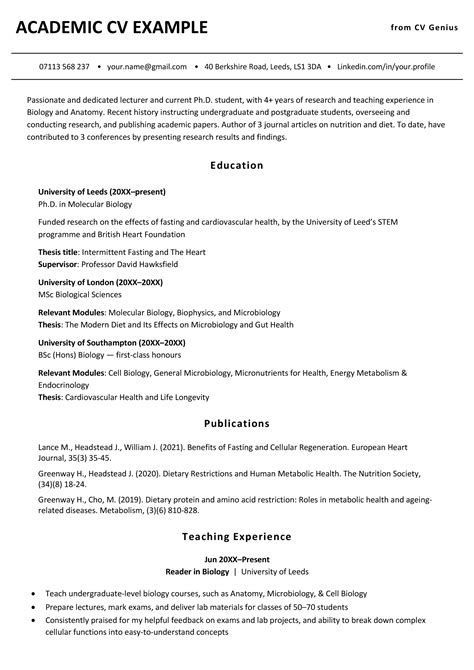
Keep this part brief. Include your full name, city and country, a professional email, and a phone number with your country code. Add a LinkedIn profile only if it is active and well maintained. Skip your full home address, marital status, or national ID number, unless a specific portal asks for it.
Academic Summary
Write two to four lines summarizing who you are academically. Mention your field, your strongest achievement, and your direction. Avoid generic filler like “hardworking and passionate individual.” Instead, be specific. This short paragraph should read like a tight thesis statement about your candidacy.
Education
List your qualifications starting with the most recent one. Include the institution name, degree title, dates attended, and your grade if it strengthens your case. If you completed a thesis or major project, add one line describing it. This often connects your CV directly to your intended field of study.
Research Experience
This section carries real weight for postgraduate and PhD scholarships. List each project with the institution, your title, the timeframe, and two or three bullet points. Describe what you actually did, and what came out of it. Use active verbs like designed, analyzed, or led, rather than vague phrases such as “was involved in.”
Publications, Conferences, and Presentations
If you have publications, list them in a standard citation style like APA or Harvard. Put the most recent one first. Include conference papers and presentations too. If you have none yet, that is completely fine. Simply leave this section out, rather than padding it with unrelated content.
Academic Awards and Honors
List your scholarships, honor roll placements, and academic competitions. Include the awarding body and the year. This section signals merit directly to a scholarship panel, so give it the space it deserves.
Work and Professional Experience
Include roles that connect to your academic direction or that show transferable skills. Think leadership, communication, or analytical thinking. For each role, note the organization, your title, and the dates. Then add two or three achievement focused bullet points. Quantify your results wherever you honestly can. For example, write “trained fifteen new staff members” instead of “responsible for training.”
Skills, Languages, and Certifications
Group these clearly by category. State your language proficiency with a specific level, such as IELTS 7.5 or native French speaker. List technical skills relevant to your field, like statistical software or coding languages, rather than a long generic list.
Leadership, Volunteering, and Extracurricular Activities
Scholarship committees, especially government funded ones like Chevening and Fulbright, actively look for leadership potential. Include roles in student unions, volunteer groups, or community projects. Add a short line about the impact you created in each one.
References
State that references are available upon request. Or list two academic referees directly, with their title, institution, and contact details, if the portal requires this on the CV itself.
Step by Step Process to Write Your CV
Follow these steps in order, and the writing process becomes much easier.
First, read the scholarship requirements carefully. Every program values different things. A research heavy fellowship wants publications up front. A leadership focused award like Chevening wants your impact front and center instead.
Next, collect everything before you format anything. List every qualification, project, award, job, and activity you have. Include even the ones that feel minor right now.
Then choose your strongest six or seven categories, and cut the rest. A CV crowded with weak entries only dilutes your strongest points.
After that, write your bullet points using a simple formula. State the achievement, then state the impact.
Once your content is set, order your sections based on your real strengths, not a fixed template. If research is your strongest asset, place it above your work experience.
Finally, proofread twice, and ask someone else to read it too. Typos and mismatched dates are one of the fastest ways to lose credibility with a reviewer. And always tailor a fresh version for each scholarship, rather than sending the same generic file everywhere.
Common Mistakes That Get CVs Rejected
Avoid these mistakes, because they show up constantly in rejected applications.
Writing in long paragraphs instead of clear bullet points Including irrelevant personal details, like religion or unrelated hobbies Using vague, unquantified statements instead of specific achievements Submitting the exact same CV to five different scholarships Ignoring the required format or page limit in the guidelines Using inconsistent dates or titles that do not match your transcripts Adding decorative graphics or color blocks that confuse reviewers and tracking systems
A Simple CV Structure You Can Copy
Here is a clean structure you can adapt for your own CV.
Full Name City, Country, Email, Phone, LinkedIn
Academic Summary Two to four lines on your field, direction, and goal.
Education Most recent degree first, institution, dates, grade.
Research Experience Project title, institution, dates, key contributions.
Publications and Conferences Citation style listing, most recent first.
Academic Awards and Honors Award name, body, year.
Work Experience Role, organization, dates, achievement bullet points.
Skills and Languages Grouped by category with proficiency levels.
Leadership and Volunteering Role, organization, dates, impact created.
References Available upon request, or listed directly.
How to Tailor Your CV to Specific Scholarships
Different scholarships reward different strengths, so tailor your CV accordingly.
DAAD wants a clear academic and research focus, since most awards fund postgraduate study in Germany. Push your research interests and any German language skills higher up the page.
Chevening and Commonwealth place heavy weight on leadership and future impact in your home country. So your leadership section deserves real space, not just one afterthought line.
Fulbright reviewers care about cultural exchange alongside academic merit. Weave in activities that show you as a community ambassador, not just a student.
Erasmus Mundus consortiums are often research and coursework focused. A clean education section, with relevant coursework listed, will serve you well here.
Whatever program you target, always check the official guidelines first. Some programs, like certain European ones, require a specific format such as Europass.
Official Scholarship Portals to Bookmark
Apply directly through these official channels. Always confirm current deadlines and document requirements before you submit anything.
DAAD Scholarship Database: https://www.daad.de
Chevening Scholarships: https://www.chevening.org
Fulbright Foreign Student Program: https://www.fulbrightonline.org
Commonwealth Scholarships: https://www.cscuk.fcdo.gov.uk
Gates Cambridge Scholarship: https://www.gatescambridge.org
Rhodes Scholarships: https://www.rhodeshouse.ox.ac.uk
Frequently Asked Questions
How long should an academic CV be for a scholarship application?
Keep it to one or two pages for undergraduate and master’s applicants. PhD and research fellowship applicants can go up to three pages, if their publication record supports it.
What is the difference between an academic CV and a motivation letter?
Your CV is a structured, factual record of your education and achievements. Your motivation letter tells the story behind those facts. Both need to align closely with each other.
Should I include a photo on my scholarship CV?
Only if the application specifically asks for one. Most international boards, including DAAD, Chevening, and Fulbright, never require a photo.
Do I need publications to apply for a research scholarship?
No, not usually. Undergraduate and early master’s applicants rarely have any. Strong research assistant roles and solid academic performance can carry equal weight at that stage.
Conclusion
A well written CV can strengthen your scholarship application, but it rarely wins a scholarship on its own. A poorly prepared one, however, can quickly eliminate you from consideration. That is why your CV should be treated as a strategic document, rather than a routine formality.
Tailor your CV to the specific scholarship or programme you are applying for. Place your strongest qualifications and achievements where they are easy to find. Use clear numbers to demonstrate your impact whenever possible, and keep the layout clean, professional, and easy to scan.
Once your CV is complete, give the same level of attention to your motivation letter and recommendation letters. Scholarship committees evaluate your application as a complete package, not as separate documents. Every section should reinforce the same message, creating a clear and consistent story from the opening page to the final recommendation.